Children's book reading age guide: what changes from 0 to 12
Choose a children's book reading age. Compare vocabulary, sentence length, page count, story complexity, and illustration needs from ages 0 to 12.
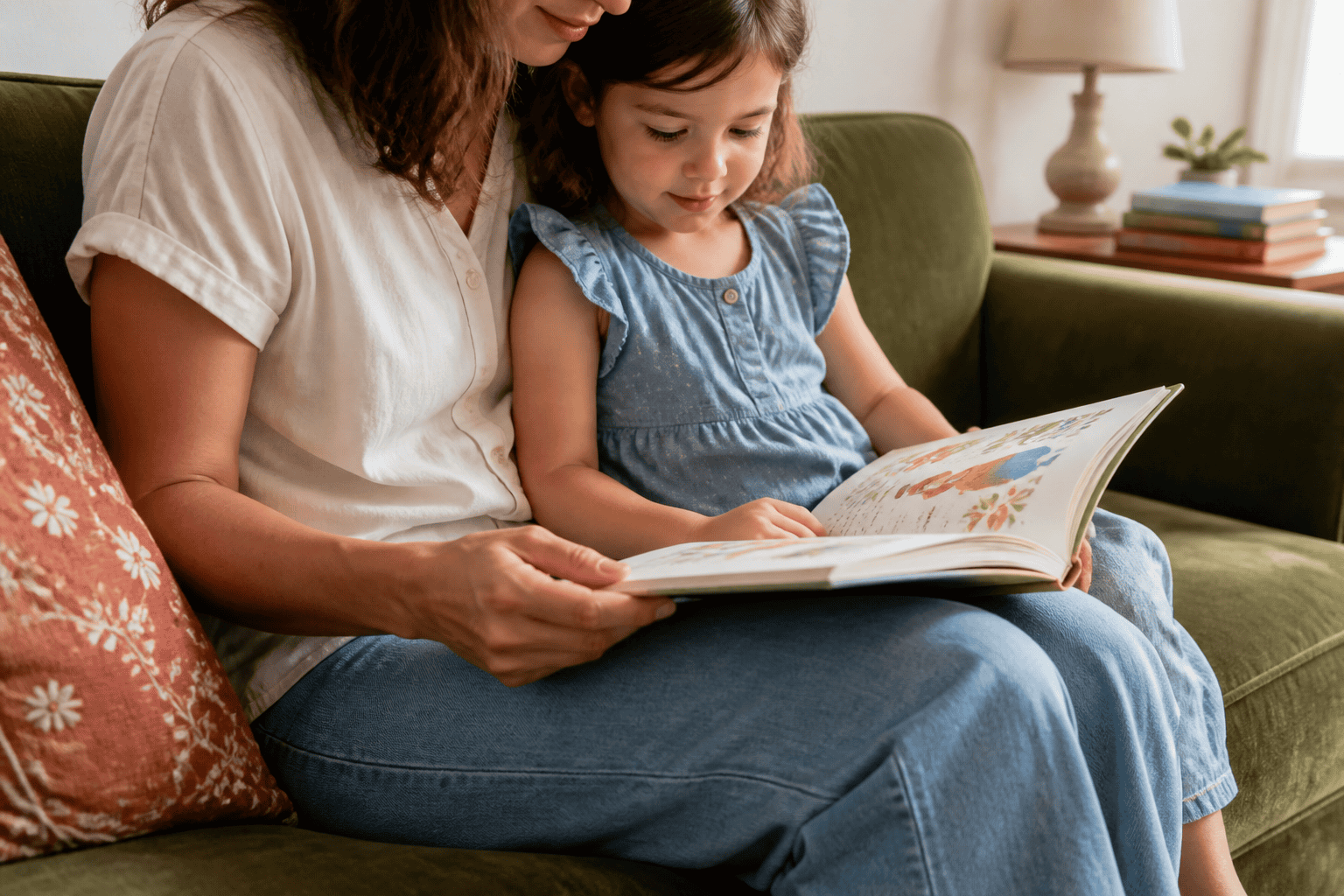
A reading age is a planning tool. It helps an adult choose vocabulary, sentence length, page count, story complexity, and illustration density for a particular child or group of readers. It is not a strict grade level, and a child can read above or below the band that matches their age.
This guide covers five bands used in WhimKid: 0 to 3, 4 to 6, 5 to 7, 7 to 9, and 9 to 12. Use it before writing a story, prompting an AI storybook tool, or reviewing a draft with a child.
Quick comparison
| Band | Typical reader | Language | Story shape | Page count | Illustration needs |
|---|---|---|---|---|---|
| 0 to 3 | Toddler, read aloud | Few words per page, repetition, concrete nouns | Routine, comfort, simple sequence | 10 to 16 | Large faces, clear shapes, high contrast, little background clutter |
| 4 to 6 | Preschool and early picture book | Short sentences, predictable refrains, simple dialogue | One problem, familiar setting, warm ending | 16 to 24 | Expressive characters, clear action, visual clues for the words |
| 5 to 7 | Early reader bridge | Longer sentences, manageable vocabulary, more dialogue | Clear sequence, small stakes, a problem solved with help | 20 to 30 | Character consistency across scenes, readable expressions, simple page turns |
| 7 to 9 | Chapter book transition | Paragraphs, varied sentences, some descriptive language | Chapters, a larger problem, humor or mystery, secondary characters | 30 to 60 | Fewer full spreads, more spot illustrations, clear scene changes |
| 9 to 12 | Middle grade | Rich vocabulary, figurative language, subtext | Subplots, character change, moral tension, a satisfying resolution | 60 to 150 | Cover and chapter art, visual tone that respects older readers |
Ages 0 to 3: rhythm, safety, and recognition
Books for this band are usually read aloud. The child may turn pages, point at pictures, or repeat a sound. The text should be short enough to finish before attention moves elsewhere.
Use a small number of words per page. Repeat a phrase or sound pattern. Choose concrete nouns and familiar routines: bedtime, bath, food, a pet, a parent, a favorite toy. The story can be a simple sequence of events with a calm ending.
Illustrations should be easy to recognize. Large faces, clear silhouettes, and strong contrast help. A crowded background can make it harder for a toddler to find the main subject. If the book is generated with AI, check that the main character stays recognizable and that no page is visually overwhelming.
Ages 4 to 6: one problem and a predictable ending
Preschool readers can follow a simple story with a beginning, a problem, and an ending. They often enjoy repetition, a repeated refrain, and a character who tries something more than once.
Keep sentences short. Use dialogue when a character speaks. The problem should be concrete: a lost toy, a noisy neighbor, a fear of the dark, a friend who will not share. The ending can be warm and predictable. A surprise works when it is set up clearly.
At this age, illustrations carry a lot of the story. The pictures should show the action and the emotion. A child may use the images to retell the story without reading every word. Check that the character's face, clothing, and size remain consistent across pages.
Ages 5 to 7: the bridge to independent reading
This band overlaps with the previous one because children develop at different speeds. A five year old may still want a picture book read aloud, while a seven year old may read simple sentences independently.
Use longer sentences and more dialogue, but keep the vocabulary manageable. Repeat new words in context. The story can have a clearer sequence and a small stake: a character wants something, faces an obstacle, and solves it with help.
Page turns should feel natural. Each spread can end with a small question or a reason to continue. If the book is 20 to 30 pages, check that the middle does not repeat the same scene. A simple subplot can add variety, as long as the main problem stays clear.
Ages 7 to 9: chapters, humor, and a larger problem
Readers in this band can handle longer text, chapters, and more developed characters. They may enjoy humor, mystery, fantasy, and stories about friendship or school.
Use paragraphs and varied sentence lengths. The story can include a secondary character, a small twist, or a problem that takes more than one attempt to solve. The ending should resolve the main promise of the story.
Illustrations become less continuous. A chapter book may use a few spot illustrations or a full-page image at key moments. Character references still matter, especially if the same character appears across several books.
Ages 9 to 12: middle grade stories with subtext
Middle grade readers can follow subplots, character change, and more complex emotional stakes. They can notice when a character says one thing and means another. The story can explore friendship, identity, family pressure, competition, or a moral choice.
Vocabulary can be richer, but clarity still matters. A difficult word should earn its place. The ending can be hopeful without solving every problem. Readers at this age may reject a story that feels too young or explains its lesson too directly.
Illustration needs shift toward cover art, chapter openers, and occasional interior images. The visual tone should respect older readers. A style that feels appropriate for a preschool book may not fit a middle grade novel.
How to choose a band
Use four practical tests:
- Read aloud test. Read the first two pages aloud. If you run out of breath or have to explain every sentence, the band may be too high.
- Word count test. Count the words on three sample pages. If the average is far above the band, shorten the text or split the page.
- Page turn test. Read the story one spread at a time. Each page turn should create a small reason to continue.
- Retell test. Ask the child to retell the story from the pictures. If the main action is unclear, the illustrations or the text need another pass.
Common mistakes
- Writing for the adult reader instead of the child.
- Using vocabulary that sounds impressive but slows the story down.
- Adding too many characters before the main character is clear.
- Making every page the same emotional intensity.
- Ending the story without resolving the main problem.
- Putting text over faces or important visual details.
- Assuming a generated character will look identical on every page.
A review checklist for AI-assisted books
Before you share an AI-generated children's book, review it as a reader:
- Check the reading age against the vocabulary and sentence length.
- Check names, pronouns, and family relationships.
- Compare the main character across the cover, early pages, middle pages, and ending.
- Look for extra fingers, missing props, distorted faces, and inconsistent clothing.
- Check that the text and image tell the same action.
- Read the ending aloud. Does it resolve the promise made at the start?
- Confirm that you have permission to use every photo or reference image.
- Open the exported PDF and check the page order, margins, and text size.
How WhimKid uses reading bands
WhimKid uses five reading bands to guide vocabulary, sentence length, story complexity, and page pacing. You choose the band before generation, then review the draft and edit the text page by page. The book remains editable, so you can simplify a sentence, change a name, or rewrite the ending after you see the full story.
The band is a starting point. The child in front of you is the real test. Read the book aloud, watch where attention drops, and adjust the text before you share it.
If you want to make a book with a specific child in mind, start with personalized story books with photos. For the full editing and export workflow, see the storybook maker. To compare tools, read the best AI storybook generators guide.